Direct drive vs wheel-on smart trainers: which should you buy?
One removes your rear wheel, the other clamps it. The choice decides noise, accuracy, setup time and what you spend. Here is how to decide, without the marketing.
Ole BirkelandFounder, Cadexa
- Published
- 23 Oct 2026
- 2 min read
 AI-generated image
Guide · Editorial recommendations based on the criteria stated in the article. How we work.
The two designs
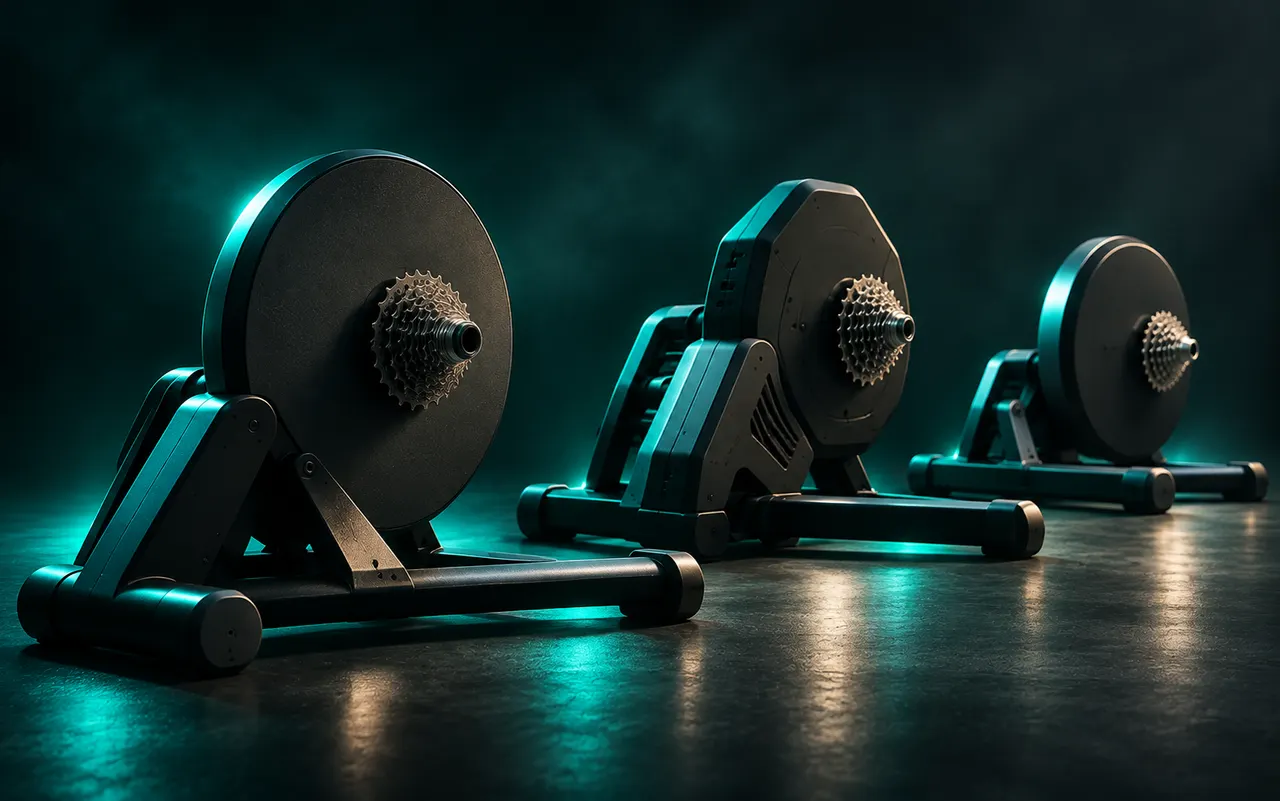
A wheel-on trainer holds the rear axle in a clamp and presses a roller against the tyre. The resistance unit brakes the roller. It is cheap to build, quick to set up and works with any bike.
A direct-drive trainer replaces the rear wheel. You mount the bike on a cassette fitted to the trainer and the chain drives the flywheel directly. It costs more, weighs more, and needs a cassette that matches your drivetrain.
Where the differences show up
Noise
The loudest part of a wheel-on trainer is the tyre on the roller, especially at speed. Direct-drive trainers removed that source; the remaining noise is drivetrain and flywheel. If you ride early mornings in a flat, this alone can decide it.
Power accuracy
Wheel-on units estimate power from roller speed and the resistance they apply, and the result depends on tyre pressure, clamp tension and temperature. Manufacturers ask you to run a spin-down calibration regularly. Direct-drive units measure or estimate at the flywheel with no tyre in the chain; claimed accuracy of ±1 % to ±2 % is common, against ±3 % to ±5 % for wheel-on.
Slip
Hard efforts on a wheel-on trainer can make the tyre slip on the roller, which ruins a sprint and wears the tyre. Direct drive has no slip.
Setup and swapping bikes
Wheel-on wins for a household with several bikes: clamp, tighten, ride. Direct drive needs the rear wheel off and a compatible cassette; a second bike with a different freehub standard means a second cassette or an adapter.
Road feel and gradient
Direct-drive flywheels are heavier and the resistance units more powerful, which is why maximum gradients of 16 % to 25 % and resistance above 2,000 W are only found in that camp. Wheel-on trainers typically top out around 10 % to 12 % and 1,500 W.
Tyre wear
A trainer tyre is advisable on a wheel-on unit; normal road tyres shed rubber and square off. Direct drive has no tyre.
Who should buy which
Buy wheel-on if you want the lowest entry price, you swap bikes often, you mostly ride endurance and noise is not a constraint. It is also the sensible choice if you are not yet sure indoor training is for you.
Buy direct drive if you train by power, you do intervals or sprints, you share walls or floors with other people, or you want to ride real routes with steep gradients. Most riders who stick with indoor training end up here.
A note on protocols
Both designs can implement Bluetooth FTMS and ANT+ FE-C; the design does not decide compatibility. For the Cadexa app, FTMS is the requirement, and you can check any listed trainer in the compatibility checker.
Shortlists
Our specification-based lists for each design are maintained in Best smart trainers. Every entry there states the selection criteria.
About the author
Ole BirkelandFounder, Cadexa
Builds the Cadexa indoor-cycling app in Bergen, Norway, which means living inside the Bluetooth FTMS specification and watching how trainers actually respond to it. Writes the technology explainers and runs the compatibility tests.
Related reading
Smart trainers
Best smart trainers for indoor cycling: a specification-based shortlist
No hands-on testing yet, and we say so. This shortlist is built from manufacturer specifications with sources, organised by the decisions that matter: drive type, price band, protocols and gradient.
Smart trainers
Bluetooth FTMS explained: the protocol that lets an app control your trainer
Every modern smart trainer speaks FTMS. Here is what the Fitness Machine Service actually does, what the control point commands are, and why “supports FTMS” does not guarantee that every app feature works.
Smart trainers · Wahoo Fitness
Wahoo KICKR CORE 2: features and compatibility
What changed from the original CORE, what did not, and how the second generation lines up with Bluetooth FTMS control from a phone. A specification-based overview ahead of our hands-on test.